

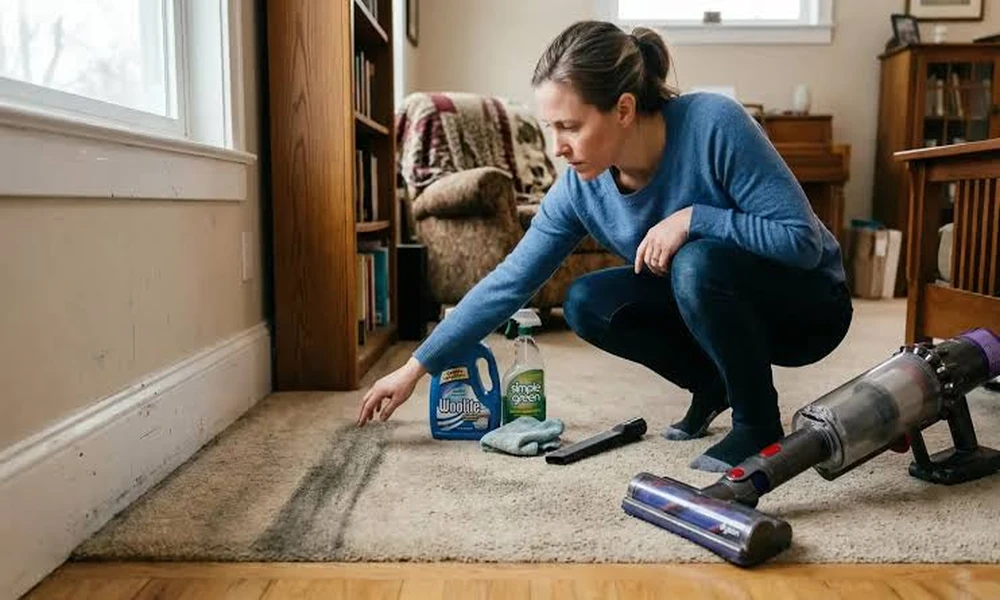
Dark lines near walls, beneath doors or around vents can be a form of filtration soiling rather than an ordinary spill. That possibility calls for an informed carpet-care assessment, not an automatic increase in cleaner or scrubbing. The pattern may also raise an airflow question that cleaning alone cannot answer.
Follow the line before choosing a stain treatment
A Markham homeowner may first notice the mark while vacuuming beside a skirting board. The main floor looks acceptable, yet the narrow edge remains grey or dark. It is tempting to conclude that the vacuum missed the area for too long. That may be an incomplete explanation, particularly when similar lines appear in several specific locations.
The Carpet and Rug Institute’s care guide describes filtration soiling as fine airborne soil deposited through airflow over or through carpet. It identifies characteristic locations such as walls and doorways and notes that specialist treatment may be needed. This is a possible explanation to investigate, not a diagnosis that can be made from every dark edge.
Look at the distribution without disturbing the floor. Does the mark follow a doorway line, appear around a vent or continue along several wall edges? Describe those relationships to a carpet-cleaning professional. A wider view of the pattern is often more informative than a close photograph of one dark centimetre.
Keep other possibilities open. A local spill, a material change or a different type of soiling may require another response. Colour alone cannot identify the substance or cause. If the area is associated with water damage or another unusual event, include that history rather than applying a convenient name to the mark.
Fine deposited soil may need specialist cleaning
A routine extractor enquiry should disclose the edge condition. Markham extractor rentals from Drying Equipment are one equipment route for suitable cleaning, but the existence of the category does not establish that ordinary extraction will remove an established filtration line. Ask about the intended method after the carpet and the problem have been assessed.
A narrow mark can look like a small job while remaining difficult to treat. Its width does not determine how readily the soil will release or whether the colour can be fully restored. Set that expectation before deciding that a whole-machine rental is the obvious remedy for a line along one doorway.
Avoid aggressive brushing to force a match with the surrounding pile. The edge may be awkward to reach, and repeated mechanical treatment can introduce a second concern about the carpet’s condition. Use the manufacturer’s permitted care and obtain professional advice about a persistent deposit rather than treating effort as a substitute for a suitable method.
Likewise, a stronger or improvised chemical does not resolve uncertainty about the soil. Do not assemble a sequence of household products because the first one made little visible difference. The cleaner needs to suit the fibre, colour and construction, as well as the assessed issue. Specialist treatment is valuable precisely because those factors need to be considered together.
Cleaning the line does not explain the air route
If filtration soiling is the explanation, removing some visible deposit is a cosmetic and maintenance intervention. It does not establish why air and fine soil reached that location. The building may need a separate assessment if the pattern is persistent or accompanied by another concern about its operation.
Do not infer a defective ventilation system from a carpet photograph. A visible line provides an observation for an appropriate professional, not a measurement of system balance. Explain the locations and any relevant changes to the home, then let the assessor decide what further investigation is justified.
Nor should a homeowner seal gaps, block vents or change door clearances solely to prevent another line. Those features may interact with the building’s intended ventilation and heating arrangements. An alteration made for appearance can affect a function that has not been considered. Seek qualified advice before changing building airflow paths.
A portable air cleaner should not be promised as a cure for the edge pattern either. An enquiry about airborne particles is a separate equipment decision with its own evidence and limitations. It does not eliminate the need to understand the deposit or automatically make an alteration to the ventilation system unnecessary.
Keep the cleaning and building conversations connected through the actual observation. The carpet professional can explain the treatment and its limits; a relevant building professional can address an airflow concern if one warrants investigation. Neither should be asked to certify the other’s work merely because both discussions began with the same dark line.
Accept the limits of a cosmetic result
Some established marks may remain visible after suitable treatment. Ask the carpet professional what improvement is realistic before repeating the work. A result that is better but imperfect may be the appropriate stopping point, especially when further treatment is not supported by the material’s care requirements.
Evaluate the floor after the approved process is complete, under comparable lighting and conditions. A dark wet edge and a dry surrounding area are not a fair appearance comparison. Follow the cleaning advice through to the appropriate evaluation point rather than judging mid-process and adding another pass impulsively.
If the line later returns, record where and under what circumstances without assuming a particular cause. The earlier assessment and treatment details can help frame a useful follow-up. Recurrence is a reason to revisit the explanation, not proof that a stronger version of the same cleaning process is required.
A dark edge can tell a more interesting story than a missed vacuum pass. Give that possibility the attention it deserves while keeping claims modest. Appropriate cleaning may improve the carpet, and further assessment may explain the pattern; the two results should be sought and judged on their own terms.
