

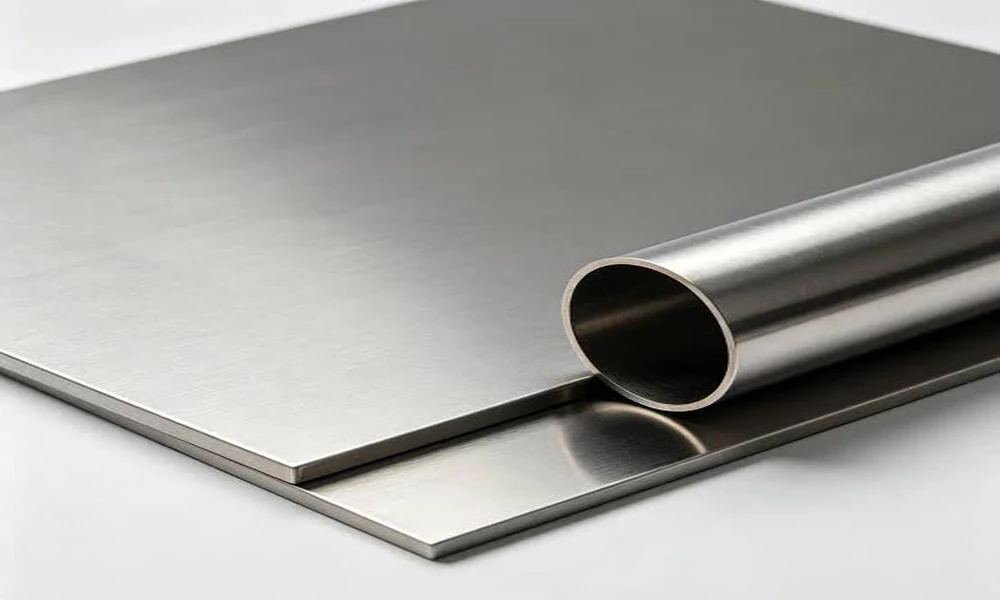
Type 304 stainless steel appears on more commercial washroom specifications than any other accessory material, and the reasons are metallurgical rather than aesthetic. The alloy contains roughly 18 percent chromium and eight percent nickel, the composition behind its common “18-8” designation (Specialty Steel Industry of North America). That chemistry determines how accessories hold up to water, cleaning chemicals, and years of daily contact.
What makes Type 304 resist corrosion?
Type 304 resists corrosion because its chromium content forms a thin, self-renewing oxide layer on the surface. When the surface is scratched, the layer reforms in the presence of oxygen, protecting the steel underneath. This passive film is the reason stainless accessories can tolerate the constant moisture and splashing found at lavatories and in shower areas.
How does nickel contribute?
Nickel stabilizes the austenitic structure of the alloy, which improves formability and toughness. That structure allows manufacturers to draw, bend, and weld accessories such as dispensers and grab bars into complex shapes without sacrificing strength or surface quality.
How broad is the Type 304 accessory market today?
The Type 304 accessory market now covers nearly every washroom function. Product lines from a single manufacturer can include more than 3,000 washroom accessories, most fabricated from Type 304 stainless steel and organized into six curated collections (American Specialties). That breadth lets designers keep one material and finish across soap, towel, waste, and grooming fixtures.
Why does finish consistency matter?
Finish consistency matters because mismatched satin grain or tone is immediately visible on a long lavatory wall. Coordinated collections reduce the risk of combining accessories from different sources that never quite match once installed, a problem that often surfaces only after the contractor has left the site.
Which standards define stainless sheet used in accessories?
Stainless sheet used in fabricated accessories is commonly produced to a widely referenced standard specification for chromium and chromium-nickel stainless steel plate, sheet, and strip (ASTM International). Referencing a recognized standard in a specification gives owners and contractors a verifiable basis for comparing competing products.
Why does gauge matter?
Gauge matters because thicker material resists denting, flexing, and tampering in high-traffic restrooms. Specifiers typically review gauge alongside alloy type, since a thin component in the right alloy can still fail mechanically long before it ever shows corrosion.
How does stainless steel support sustainability goals?
Stainless steel supports sustainability goals because it is fully recyclable at the end of its service life without losing its properties. Steel is the most recycled material in North America by weight (Steel Recycling Institute). Long service life also reduces replacement frequency, which lowers the material and labor footprint of a restroom over time.
What role does cleaning chemistry play?
Cleaning chemistry plays a large role in how stainless ages. Neutral cleaners and soft cloths preserve the passive layer, while chloride-heavy products and abrasive pads left on the surface can leave marks that look like corrosion but are really surface damage.
What should specifiers verify on submittals?
Specifiers should confirm several details before approving stainless accessories:
- Alloy designation listed as Type 304 on each component
- Gauge of the primary body and doors
- Finish description, such as satin or bright polish
- Concealed fastening and tamper-resistant hardware where needed
Where does Type 304 perform best?
Type 304 performs best in interior washrooms, locker rooms, and healthcare restrooms where moisture and cleaning are constant but salt exposure is limited. Coastal pools and facilities near road salt sometimes call for a higher-alloy grade, so specifiers should note the environment early and confirm the right grade with the manufacturer before finalizing the schedule.
What is the takeaway for washroom planning?
Type 304 earns its place as the benchmark through chemistry, fabrication flexibility, and recyclability. Planners who specify the alloy by name and verify gauge and finish get accessories that look consistent on day one and keep performing long after installation.
